





If it were not already apparent Amos of Tekoa was not sent to Israel to make friends, it would become painfully obvious once he condemned the elite women of Israel and sarcastically castigated their service to YHWH in Amos 4:1-5. It is almost a wonder he was not immediately seized and punished for what he had to say.
YHWH had called Amos for a moment away from his flocks and sycamore trees in Tekoa, a village south of Jerusalem in Judah, to proclaim His word to Israel a couple of years before the big earthquake around 760 BCE (Amos 1:1, 7:14). Amos had begun with a series of accusations and condemnation of all the nations in the southern Levant, finally arriving at Israel itself (Amos 1:2-2:16). He warned about YHWH’s impending punishment for their covenant violations (Amos 3:1-2), for YHWH had spoken, and therefore Amos had to prophesy (Amos 3:3-8).
We deem Amos’ denunciation of the elite women of Israel as Amos 4:1-3, yet in context this denunciation seems to conclude a series of such indictments which began in Amos 3:9: Egypt and Philistia were invited to see the oppression and violence the Israelites were committing, and how a superior enemy would plunder them (Amos 3:9-11); as a shepherd might present to its owner a few pieces of a sheep to its owner as evidence of destruction by a lion, so only a few pieces of a bed or a couch might be salvaged from Israel (Amos 3:12); YHWH promised to destroy the altars at Bethel and the great mansions and multiple dwellings of the elite on that day (Amos 3:13-15). And so, likewise, the “cows of Bashan,” who demanded their husbands provide them with more drink, would be carried away and thrown out (Amos 4:1-3).
Bashan was in Gilead in the Transjordan, not terribly far from the Golan Heights of today, and was famous for its high-quality pasturage (cf. Numbers 21:33, 32:33, Deuteronomy 32:14). By “cows of Bashan” living on “Mount Samaria,” Amos referred to the well-fed and maintained wives of the elite living in Samaria, the capital of Israel. Since we find some positive comparisons between animal flocks and women’s anatomy in Song of Songs 4:1-2, 6:5-6, we should not assume the Israelites would automatically find Amos’ description as offensive; nevertheless, he certainly was not speaking of them positively or warmly by means of the comparison.
Amos indicted these women for oppressing the poor and crushing the needy and demanding their husbands provide them with more drink (Amos 4:1). We should not imagine Amos thought they were the ones actively and personally oppressing the poor; instead, their husbands were active and personally doing so, and they were the beneficiaries of that behavior. Their husbands might well have been active in doing so, at least in part, because of the continual cravings and desires of their wives which they wanted to satisfy.
YHWH swore on His holiness: these women would be lifted up or carried away by or on a tsinot (we do not know exactly what this word means; such is why it is translated as “shields,” “hooks,” “baskets,” or “ropes” in various translations) or in sirot dugah (seemingly literally “pots of fishermen,” but because of the parallelism, “hooks” is also suggested); they would go out in the breaches, or holes in the walls, and would “cast themselves” (as rendered in the Masoretic Text) or would “be cast” toward “Harmon” (Amos 4:2-3). We cannot make sense of “Harmon” as rendered: while it is perhaps some unknown place name, most believe we do best to amend the text somehow, either to “Hermon,” a mountain appropriately in the Transjordan Gilead near Bashan, or to similar words referring to a dung heap or a fortress. As we can tell, the textual issues related to Amos 4:2-3 complicate our ability to understand its particular meaning, but Amos warned the elite women of Samaria they were going to suffer one of two quite unpleasant futures. Either they would be captured alive, dragged through the breaches made in the walls of the successfully invading enemy with some kind of hook or something of the sort, destined for slavery, or they would be killed, their corpses unceremoniously dragged and dumped. Even if they themselves were not the direct agents of oppression and exploitation, they would experience what it was like to be oppressed and exploited soon enough.
If Amos 4:1-3 looked backward, so to speak, to conclude the series of prophetic oracles which began with Amos 3:9, then Amos 4:4-5 looked forward, introducing a new series of messages from YHWH. At first, it might seem Amos was inviting Israel to serve God by going up to Bethel and Gilgal, bringing and offering sacrifices and presenting their tithes; yet Amos was setting them up for a sarcastic invitation and biting denunciation, inviting them to go to Bethel and Gilgal to rebel in these ways as the Israelites loved to do (Amos 4:4-5).
The Kings author would condemn all Israel for the place and types of service they would offer to YHWH as not commended by Him and in direct rebellion against His purposes to maintain His name and presence in Jerusalem (1 Kings 12:25-33). While Bethel was one such place established by Jeroboam ben Nebat, Dan was the other; Amos instead mentioned Gilgal, on the Jordan River near Jericho, where Israel first crossed the Jordan and Joshua set up the twelve stones taken from the Jordan River (Joshua 4:19-20). Hosea would also bear witness regarding cultic activity taking place in Gilgal, and so we have reason to believe there was some kind of temple or altar set up there (Hosea 9:15, 12:11). Therefore, it remains possible Amos was condemning all the offerings the Israelites were making as rebellious because they were not being offered in Jerusalem at the Temple.
Nevertheless, “rebel” was the strongest possible word which Amos could have used to describe the transgressions taking place. Amos was not merely condemning the Israelites on what many might deem a technicality; he was condemning them for vainly imagining they could continue to go to these cultic sites, perform the requisite sacrifices and give the requisite donations, and that would mean all would go well for them. Their rebellion in other ways, maintaining the exploitative and oppressive systems and behaviors for which Amos had already roundly condemned them in Amos 2:6-16, 3:9-4:3, could not be so easily atoned. The Israelites could not imagine they could live in ways which powerfully transgressed their covenant with YHWH and then think they could offer YHWH sacrifice and everything would be well and good. Far, far from it.
Amos of Tekoa stood before the Israelites and condemned the elite among them for their exploitation and oppression of others. He sarcastically denounced their attempts at fastidious religious observance as increasing rebellion. He warned about the dangers to come.
But the Israelites would not hear him. Granted, the elite of the Kingdom of Israel had prospered recently in ways their ancestors could have only imagined, but Israel had been a going concern for the better part of two hundred years. Were they really that much worse than their ancestors? Had they and their ancestors not brought offerings, sacrifices, and tithes to Bethel and Gilgal and other places all this time, and were not all things going as they had for quite some time? Israel was enjoying a wonderful moment of prosperity, and they could have easily imagined their good fortune continuing for some time. Why, then, should they take this southern “crank” seriously?
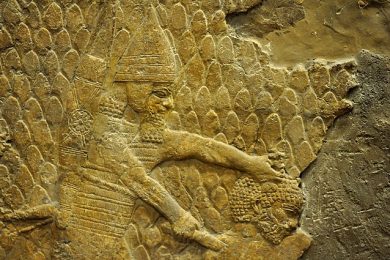
Within a generation, all Amos prophesied came to pass. Shalmaneser V and Sargon II of Assyria would besiege and conquer Samaria in 722/721 BCE (cf. 2 Kings 17:1-6). The Assyrians would eventually exile a good number of the people to Assyria, but they would have no doubt plundered Samaria thoroughly, slaughtered untold thousands of people, and enslaved a good number of the remaining women, especially those among the elite. While being dragged off into slavery, or while watching Assyrians or others drag corpses out into trash heaps, maybe some of the older Israelites would have remembered the words Amos had spoken against them. It would not have provided them any relief in their distress.
The Word of YHWH through Amos was recorded and preserved for our understanding (cf. Romans 15:4, 2 Timothy 3:15-16). From Amos 4:1-3 we can see how those who materially benefit from exploitation and oppression are held as responsible for such abuse as those who actively perpetrate it. We should not deceive ourselves into thinking as long as we offer appropriate, right, and timely service and devotion to God in Christ, all will be well despite persevering in perpetuating terrible sins against other people at the same time. We might enjoy times of good fortune and think all has been well with us, all is well with us, and therefore all will be well with us. And we might well enjoy good times for quite some time. Yet such “normalcy” does not commend, excuse, or justify the exploitation, oppression, and rebellion which may be perpetuated; everything will seem “normal” until it no longer will be, and judgment and reversal is often swift and appropriate. As the elite Israelites leveraged their power and authority to exploit and oppress the poor and needy among them, so they would suffer exploitation and oppression themselves when overtaken by the Assyrians. That same cycle has persevered until this day.
Instead, we do better to heed the warnings of the prophets and, as Amos would soon tell Israel, allow justice to flow like torrents of water, and display righteous actions like a never-ending stream (Amos 5:24). May we seek to serve the Lord Jesus in justice, righteousness, and truth, doing good to all people, and finding life in Him!
Ethan R. Longhenry