


The Word of YHWH through Micah of Moresheth would not feature many pleasantries. From the beginning it reflected the witness of YHWH against His people in Samaria and Jerusalem. Its fulfillment would not take terribly long.
The Word of YHWH came to Micah of Moresheth in the days of Jotham, Ahaz, and Hezekiah, kings of Judah (ca. 742-680 BCE; cf. Micah 1:1). Moresheth was a village in southwestern Judah where the Shephelah met the Philistine coastal plains. Micah, therefore, was not a prophet of the city, but from the rural hinterlands. At the time Micah began prophesying, much had been consistently the same for generations; when everything prophesied in Micah 1:2-16 would find its fulfillment by the end of the eighth century BCE, the Kingdom of Israel would be no more, and the Kingdom of Judah would be thoroughly ravaged. If all Israel and Judah had to go on were historical trends and their own foreign policy schemes, it would be understandable why they might have been taken off guard by what would befall them in the last third of the eighth century BCE. Yet the prophets Amos and Hosea had warned them, and Isaiah and Micah were warning them, regarding what YHWH was about to do.
The Word of YHWH through Micah began with a summons for all the nations and the inhabitants of the earth: YHWH had His accusation which He would make against them (Micah 1:2). YHWH was about to come down from His dwelling place; He would crush the mountains and the valleys would split apart like wax before fire and water poured down a steep slope (Micah 1:3-4). These powerful images presented YHWH as on the march, bringing forth judgment among the nations. This judgment was coming about on account of Israel and Judah: Micah identified Samaria as the “transgression of Jacob,” and Jerusalem as the “high places of Judah,” most likely considering them as places for idolatry and sin (Micah 1:5). Judgment, therefore, was coming for Samaria and Jerusalem.
Micah would begin with the condemnation of Samaria. YHWH would turn Samaria into a heap of ruins, a place better fit for vineyards than urban habitation (Micah 1:6). The valleys around Samaria would be filled with her ruins; the foundations of buildings would be exposed; her idols would be smashed to pieces or melted down (Micah 1:6-7). Micah expanded on the last with a visceral indictment: the metal idols came from the metal coins of prostitutes, and would again be made into coins and become the pay of prostitutes once more (Micah 1:7). Micah declared he would lament and wail and strip naked because of these things, embodying the great grief and experience of exile which would come upon the Israelites as a result of these things (Micah 1:8). Micah lamented how the wound or disease of Samaria was incurable, and it had spread to Judah and the gate, or more specifically the rulers, in Jerusalem (Micah 1:9).
Micah 1:6-9 seems to represent the totality of what Micah would see regarding Samaria; this oracle likely represents the first one given by YHWH to Micah, and would make sense as given in the waning days of Jotham king of Judah in the early 730s BCE. At any rate, the prophecy would have been uttered before Shalmaneser V/Sargon II besieged and captured Samaria ca. 722/721 BCE, fulfilling the general sentiment of what YHWH had spoken through Micah (cf. 2 Kings 17:3-6, 18:9-11). The Assyrians, Babylonians, and Persians in turn would use Samaria as an administrative center. The city would be razed to the ground in a rebellion against Alexander the Great and would be rebuilt by Macedonian colonists. Thus Samaria would eventually be destroyed and would no longer be inhabited by Israelites or many Samaritans; its idols were smashed and melted down just as YHWH promised through Micah.
Micah then turned to address many of the villages and cities of the Shephelah of Judah in ways which featured a lot of assonance and performative evocation of idioms and themes with which his local audience would be familiar. The news should not be spread in Gath, and no tears should be shed (Micah 1:10; cf. 2 Samuel 1:20). In Beth Leaphrah (“House of Dust”) they should mourn in the dust (Micah 1:10). Those in Shaphir (“Pleasant”) should pass by in nakedness and humiliation (Micah 1:11). Those in Zaanan (“go out”)…did not; they have not escaped (Micah 1:11). Beth Ezel (“house of proximity”) would mourn, having been despoiled (Micah 1:11). Those in Maroth (“bitter”) hope for good, but disaster would come against Jerusalem (Micah 1:12). Those in Lachish (“team,” as in “team of horses”) should hitch horses to chariots in preparation; Lachish served as sin for the daughter of Zion, for Israel’s sin was found in her (Micah 1:13). Lachish would have to bid farewell to Moresheth Gath (“possession of the winepress,” believed to be Moresheth, Micah’s home town; Micah 1:14). Achzib (“place on the dried up river”) would prove as disappointing as a dried well for Israel’s kings (Micah 1:14). Mareshah (“conqueror”) will be attacked by a conqueror (Micah 1:15). As David had escaped and found refuge in a cave at Adullam, so the glory of Israel would go to Adullam (Micah 1:15; cf. 2 Samuel 22:1). Micah concluded this section of his oracle with a painful, biting exhortation: they should shave their heads in mourning for their beloved children who would be taken from them into exile (Micah 1:16).
What is Micah attempting to accomplish in Micah 1:10-16? We do well to remember whereas the Word of YHWH to Micah concerns Samaria and Jerusalem, he remains Micah of Moresheth (Micah 1:1). Many imagine or assume he delivered his oracles in Jerusalem, but the text does not require it. Even if he did have a message he would deliver in Jerusalem, we should not be surprised to find more local concerns at hand. Micah is a man of the rural hinterland living on the periphery of the Judahite world.
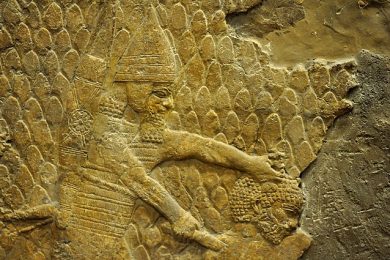
And the area in which Micah of Moresheth lived very likely saw intense military expansion and build-up during his age in preparation for possible invasion by foreign powers: the Philistines, Arameans, Israelites, or yes, even the Assyrians. These would be the “front line” communities who would first suffer in any major conflict so as to protect Jerusalem, the political and economic center of the Kingdom of Judah. And it would come to pass: Sennacherib king of Assyria began his Levantine campaign of 701 BCE along the coast, taking Sidon, Ashkelon, and Ekron by force; he then turned toward the Kingdom of Judah, and having just defeated the Philistines, his natural avenue toward Jerusalem would have begun with these villages and cities of the southwestern portion of the Judahite Shephelah. The siege and conquest of Lachish was viscerally preserved on a series of reliefs displayed in Sennacherib’s palace in Nineveh and now found in the British Museum. It would all be made a waste as Sennacherib moved on toward Jerusalem.
Therefore Micah of Moresheth gave voice to the upcoming disaster which would befall his fellow Judahites in the southwestern portion of the Shepelah. Sure, for the king and his entourage in Jerusalem, it would make a lot of sense to militarily reinforce the Shephelah to protect Jerusalem. In the process, however, his subjects in the Shephelah would suffer the full force of Assyrian might and power. We understand how YHWH would preserve Jerusalem from Sennacherib’s armies, but Lachish and all the other locations in the Shephelah mentioned in Micah 1:10-18 did not prove as fortunate: they were wiped out, with men no doubt slaughtered, and women and children enslaved and exiled (cf. 2 Kings 18:18-19:37).
All of these things might have sounded far-fetched, or perhaps even impious, in the early 730s BCE. By 721 and 701 BCE, however, they had become the bitter, harsh reality for Israelites and Judahites after YHWH’s judgment came against them in the form of the mighty armies of the Assyrians. We do well to meditate upon the fulfillment of the Word of YHWH through Micah regarding Samaria and parts of the Judahite Shephelah. Warnings of judgment and condemnation may seem far-fetched, outlandish, and even impious; how could God treat His favored people in such ways? And yet it has happened before, many times; and it could still happen today. Who knows when God will again come down from His dwelling place to crush the mountains and split the valleys and render His judgments against the nations and inhabitants of the world? May we faithfully serve God in Christ through the Spirit and entrust ourselves to Him!
Ethan R. Longhenry