


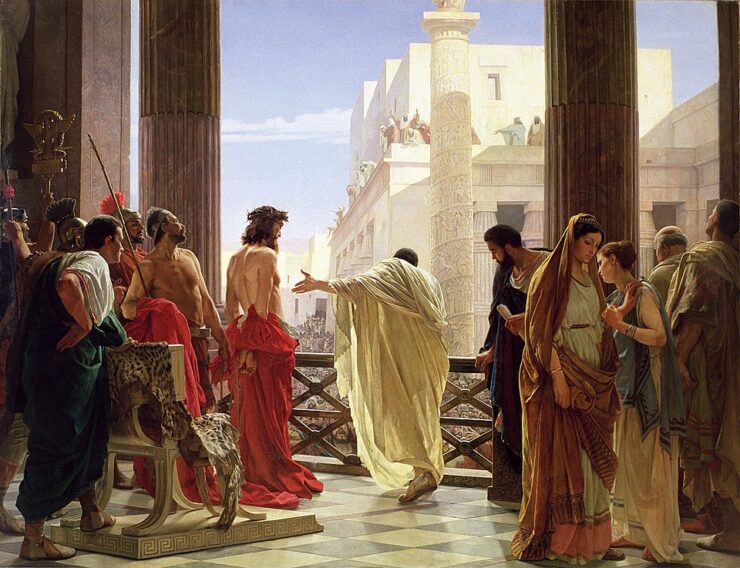
“Behold, the man!” A pathetic sight indeed. And yet, indeed, He was and is the man: the Son of Man, God in the flesh, fulfilling all which was written regarding Him.
The “disciple whom Jesus loved,” known as John, either John ben Zebedee (the Apostle), or John the Elder, wrote his recollections of his experiences with Jesus so that those who hear or read would believe Jesus is the Christ, the Son of God, and would find eternal life in His name (cf. John 20:31).
The religious authorities’ plot against Jesus was being fulfilled: they had Him arrested and examined by Annas and Caiaphas (John 18:1-26). They would then proceed to bring Jesus to Pontius Pilate, the Roman governor (John 18:27).
Pontius Pilate served as the governor of Judea from around 26-36. The role was not glorious, and Pilate would have most likely resented it: there was very little opportunity for glory, and a lot of opportunity for difficulty and failure. The population was restive and hostile against the Romans and was not easily placated. What sources we do have for Pilate align with what we can find in the four Gospels: a Roman administrator who was not a big fan of the Jewish people and their authorities, and one who would put his own craven interests before anything resembling righteousness and truth.
The religious authorities stood outside of Pilate’s residence so they might not be defiled and be unable to observe the Passover later that evening (John 18:27). The challenges reconciling the Gospel narratives in terms of when the Passover took place relative to Jesus’ death are well-attested. But we do well, here and throughout this passage, to note the intended irony: these men would not enter Pilate’s house and thus be defiled, yet seem to have no difficulty with the blood of Jesus they were bringing upon their hands.
Pilate came out and asked them what Jesus had done; they responded how they would not have brought Him if He were not a criminal (John 18:28-29). The religious authorities likely maintained this vagary because Jesus’ “crimes” were a matter of internal Jewish disputes, of little concern to the Romans; but we can perceive in their words that prejudice and propaganda which authorities often love to use against their opponents, denouncing them in general terms as criminals without presenting the details.
Pilate, who was not born the day before and perceived all this, told them to go and judge Him by their own law; they responded they did not have the authority to put anyone to death, and John the Evangelist pointed out how this fulfilled the word Jesus had spoken regarding the nature of His death (John 18:31-32). As far as we can tell, the authorities speak accurately: capital punishment had to be approved by the Roman authority. Stephen’s execution in Acts 7:1-58, as well as Josephus’ attestation of the assassination of James the Just (the Lord’s brother; Antiquities of the Jews 20.9.1), seem to represent extrajudicial killings. But this time the religious authorities want to have the authorization and blessing of the Roman authority for what they want to do, and it would work to fulfill the Scripture in Psalm 2:1-12.
Pilate went back within his residence and summoned Jesus, and they would have their first discourse in John 18:33-38a. Pilate asked Him if He were the king of the Jewish people; Jesus asked in response whether he was asking on his own or because of the testimony of others (John 18:33-34). Pilate responded brusquely: was he a Jewish person? Jesus’ own people and religious authorities handed Jesus over to Pilate; Pilate wanted to know why (John 18:35). Jesus confessed His Kingdom as “not from this world,” and the reaction of His disciples, whom He called His servants before Pilate, was the proof: if His Kingdom were of this world, they would be fighting to keep Him from thus being handed over, and they were not (John 18:36). From this Pilate understood Jesus as declaring Himself a King; Jesus affirmed it, and confessed to Pilate how He came into the world to bear witness to the truth, and those who belong to the truth listen to His voice (John 18:37). In response, Pilate asked, more mockingly, sarcastically, or facetiously than honestly, “what is truth?” (John 18:38a).
Pilate was looking for some kind of clear answer regarding who Jesus was claiming to be in order to make an efficient decision; Jesus instead bore witness to His purpose. Many have distorted what Jesus intended in John 18:36, imagining Jesus was claiming His Kingdom was entirely “spiritual” and had little to nothing to do with the world, no doubt based upon the unfortunate translation choice “of” for Greek ek in many translations. We better understand Jesus as saying His Kingdom was not “from” this world, and we see this well demonstrated in the evidence He supplied: His disciples were not fighting for Him to be delivered from His present distress.
Let none be deceived: Jesus’ Kingdom is not a worldly kingdom. It is not like the Davidic Israelite Empire, the Roman Empire, or the United States of America. There can be no such thing as a “Christian nation,” for if such were Jesus’ intent, He would have established one Himself, and He did quite the opposite. Jesus’ Kingdom, like Jesus, is from above, is a stranger to the ways of the creation in its corruption, and will be viewed dismissively or with hostility from many who benefit from the corruption within the creation. But just because the Kingdom of God in Christ is not from this world does not mean it has nothing to do with this world. Jesus’ prayer was for the will of the Father to be done on earth as it is in heaven (Matthew 6:10). Christians should bring the values of the Kingdom of God in Christ to bear in all their relationships (e.g. Ephesians 5:21-6:9). In one sense, therefore, Jesus as a King was no real threat to the Romans: He was not going to start an insurrection or rebellion against the Roman Empire. And yet the Kingdom of God in Christ would, in time, overrun and transform the Roman Empire.
Jesus was not trying to make a disciple out of Pilate; by saying those who belong to the truth hear Jesus’ voice, He not so subtly indicted the religious authorities, and Pilate himself, as not in alignment with the truth (John 18:37). Pilate’s question of “what is truth” was not uttered as a sincere quest for insight (John 18:38), but perhaps represented a sardonic rhetorical question.
We can only imagine what Pilate really thought of Jesus, but we can tell Pilate was not convinced He was any kind of significant threat. He announced to the Jewish authorities how he could find no basis for an accusation against Jesus; since they had a custom by which the Romans would release a prisoner during the Passover, Pilate asked if they wanted him to release the “King of the Jews” (John 18:38-39). They instead asked for Barabbas, whom John identified as a lestes, an insurrectionist (John 18:40).
In John’s accounting of the events, the Jewish authorities were the ones who requested the release of Barabbas as opposed to Jesus; the people, instigated by the same authorities, cry out for Barabbas in the Synoptic Gospels (Mark 15:6-11, etc.). In this way John has presented for us a pivotal moment which would define the next generation. The irony is palpable and would be remarked upon by Peter: they rejected the Author of Life and asked for a murderer to be granted to them (Acts 3:14-15). Furthermore, at this moment, they rejected the way of deliverance and salvation which God was offering them, the way of Jesus their Messiah, and instead chose a “Messiah” of their own desire: an insurrectionist. During the First Jewish War of 66-70, insurrectionists in the mold of Barabbas would take over the Jewish revolt, would be responsible for all kinds of death and devastation on account of their internal feuds, and would oversee the complete defeat of the Jewish people and the destruction of Jerusalem and the Temple. Simon bar-Kokhba would arise in 132 and be hailed as the “Messiah” who would defeat the Romans, but was also defeated by the Romans in the Second Jewish War of 132-136, after which the Romans renamed Judea as Palaestina, Jerusalem as Aelia Capitolina, and built a Temple to Zeus on the Temple Mount. All of this was presaged by this dramatic moment in 30 when the Jewish authorities chose the way of Barabbas over the way of Jesus.
Pilate, frustrated in this attempt to exonerate Jesus, tried a different method in John 19:1-5. He commanded Jesus to be scourged, or flogged (John 19:1); the Roman soldiers put a crown of thorns and a purple robe on Him, and offered Him mock devotion and honor, “hailing” the “King of the Jews,” striking Him on His face (John 19:2-3). After this, Pilate brought Jesus out before the Jewish leaders to provide evidence of how Pilate was convinced there was no basis for an accusation against Him: Pilate displayed the beaten, bloodied, humiliated Jesus wearing the purple robe and crown of thorns before them all, declaring, “behold, the man” (John 19:4-5).
Scourging, or flogging, was a common Roman punishment generally used to extract confessions or information, or just to remind everyone who was boss. It featured the use of a leather whip, sometimes with iron balls attached within the flayed thong to cause extra pain and suffering. A Roman soldier would systematically whip the victim down the back, turning the skin of the back into ribbons. The soldiers intended to further mock and humiliate Jesus with the reed, purple robe, and crown of thorns. The crown of thorns would cause significant bleeding once it was pressed down onto Jesus’ head.
It was not a customary practice for Romans to scourge people they were about to crucify; crucifixion was enough of a degrading and humiliating punishment. Pilate had Jesus scourged and humiliated in order to demonstrate the power of Roman authority over Him and to turn Him into a degraded spectacle before the Jewish authorities and people: this Man is your king? You want me to have this Man crucified, this bloodied, degraded spectacle before you? You really think this Man is a threat to us?
The Jewish authorities indeed beheld the Man, and continued to insist on His crucifixion (John 19:6). Pilate continued to resist, insisting they go and crucify Him, for Pilate found no basis on which to do so himself (John 19:7). The Jewish authorities declared they had a law demanding the execution of such a Man since He claimed to be the Son of God (John 19:8).
The claim of Jesus as the Son of God rattled Pilate for a moment; he brought Jesus back in and asked Him from where He had come, but Jesus gave him no answer (John 19:8-9). While John did not speak of it, Matthew testified to Pilate’s wife having warned Pilate regarding Jesus, for she had suffered in a dream because of Him (Matthew 27:19); Pilate would have been sufficiently superstitious as to not want to incur the wrath of the gods, which again is all the more ironic since he would soon be condemning the Son of the true and living God to death!
Pilate did not take Jesus’ silence well, and upped the ante, asking whether Jesus knew Pilate had the power to release Him or have Him executed (John 19:10). But Jesus would not countenance such power games: He declared Pilate would have no power unless it was given to him from above, but granted those who handed Jesus over to him had the greater sin (John 19:11).
Pilate did not want anything more to do with Jesus of Nazareth and wanted to release Him (John 19:12). Perhaps perceiving as much, the Jewish authorities themselves upped the ante, declaring Pilate was no friend of Caesar if he released a Man claiming to be the King of the Jews (John 19:12).
This gamesmanship worked: Pilate shifted the scene to Gabbatha, the “Stone Pavement,” to render official judgment (John 19:13). John related how it was the sixth hour, or noon, of the day of preparation for the Passover (John 19:14). Pilate presented Jesus before them, declaring Him their king; the Jewish leaders wanted Him to be taken away and crucified (John 19:15). Pilate asked them if they wanted him to crucify their king, and then they made their final declaration: they had no king but Caesar (John 19:16). After this, Pilate handed Jesus over to them to be crucified (John 19:17a).
In John’s telling of the story, Pontius Pilate really wanted no part or share in having Jesus killed, until the Jewish authorities insinuated not having Jesus killed would be a demonstration of disloyalty to Caesar. Saving Jesus of Nazareth was not worth a possibly damning report reaching Tiberius. Pilate therefore handed Jesus over to the Jewish authorities to do according to their own desires.
The confession of the Jewish authorities was quite damning and ironic. Sure, they were speaking in sycophantic ways when they declared Caesar alone to be their king; likely not one of them really or truly believed it, but said it in order to obtain their desires and seem more loyal to Caesar at that particular moment than the Roman governor himself. Yet God would not have been fooled or pleased. God should have been their king first and foremost. In confessing Caesar alone as their king, the Jewish authorities, even if only in pretense, abandoned God. As a result, within a generation, God would abandon the Jewish authorities to the wrath of their king, and the Romans would indeed come and take away their state and their temple. They crucified their King, and they would incur judgment for doing so.
We have not shied away from what John the Evangelist has made known regarding how Jesus of Nazareth was betrayed, arrested, and condemned to be crucified. While the Roman authority bore the responsibility of making the final decision, and for mocking and deriding the Lord of the universe, as Jesus Himself said, the Jewish authorities maintained the greater sin for having delivered Jesus over to them. If it were not for the decisions of the Jewish authorities, Jesus of Nazareth would not have been crucified. As Jesus Himself testified, judgment would come against the Jewish nation by the hands of those Romans in the First and Second Jewish Wars of 66-70 and 132-136: after these days of YHWH against Israel, they have never since had a temple, and have never since been able to observe the Law of Moses as written. “Rabbinic Judaism,” which grew and developed out of these existential crises, is as innovative and divergent from Second Temple Judaism and what was explicitly written in the Torah as was Christianity.
Unfortunately, ever since, many have professed to follow Jesus as the Christ and yet have inflicted violence and suffering upon the Jewish people in the name of Jesus. Such was never God’s intent for Israel; He would have them recognize Jesus’ lordship and be saved (cf. Romans 11:1-36). We bitterly confess and lament the sinful genocides committed against the Jewish people over the past 1700 years in the name of Jesus. Such were abominable and shameful.
As Christians, we must find a way to both condemn all the sinful actions committed against Jewish people while upholding what the Gospels teach regarding how the Jewish religious authorities in 30 stirred up the Jewish people to condemn Jesus, a Second Temple Jewish man from Nazareth, to death. We should also give significant meditation, and self-introspection, regarding how that could have happened, and to consider the various ways in which those who profess to follow Jesus might be the first ones ready to crucify Him afresh for having called into question many of their sacred beliefs and practices.
Almost two months after these events, Simon Peter would tell the Israelites all these things took place according to the predetermined plan and foreknowledge of God (Acts 2:23). Later testimony would make it known how Jesus thus suffered for all of our sins, and therefore we all have some share in responsibility for what He endured (Hebrews 7:27). To this end, we must all behold the Man. We see the Man in His degradation, humiliation, and suffering, bleeding all over the place, a King crowned with thorns and a pathetic sight before the people. And yet He is a King; the crown of thorns was His crown; and through His degradation, humiliation, and suffering, He overcame the power of evil and was atoning for our sins. May we all behold the Man, mourn and weep for our complicity in all He endured because of our sin, and yet find life in Him and follow Him no matter what we might have to endure!
Ethan R. Longhenry